Impasto paintings with palette knife – relief, sand and texture
Impasto paintings are not ordinary wall art. They are three-dimensional objects that begin with paint and end somewhere between painting and sculpture. Maria Moretti has worked with the palette knife technique for years – a method in which paint, sand and stones are applied so thickly to the surface that real reliefs emerge. No flat canvas, no digital print. What you see, you can feel.
Light plays a decisive role. Depending on the time of day and angle of incidence, the texture casts different shadows and new depths emerge. One and the same work can appear calm in the morning and dramatic in the evening. This living quality makes palette knife paintings something you don't simply hang on the wall – you orientate yourself around them.
Many people who see an impasto painting up close for the first time try to touch it. That is not by chance. The surface invites it. It does not look finished – not polished, not perfect. It looks like something that was made through real work. It was.
What sets palette knife art apart from other wall paintings
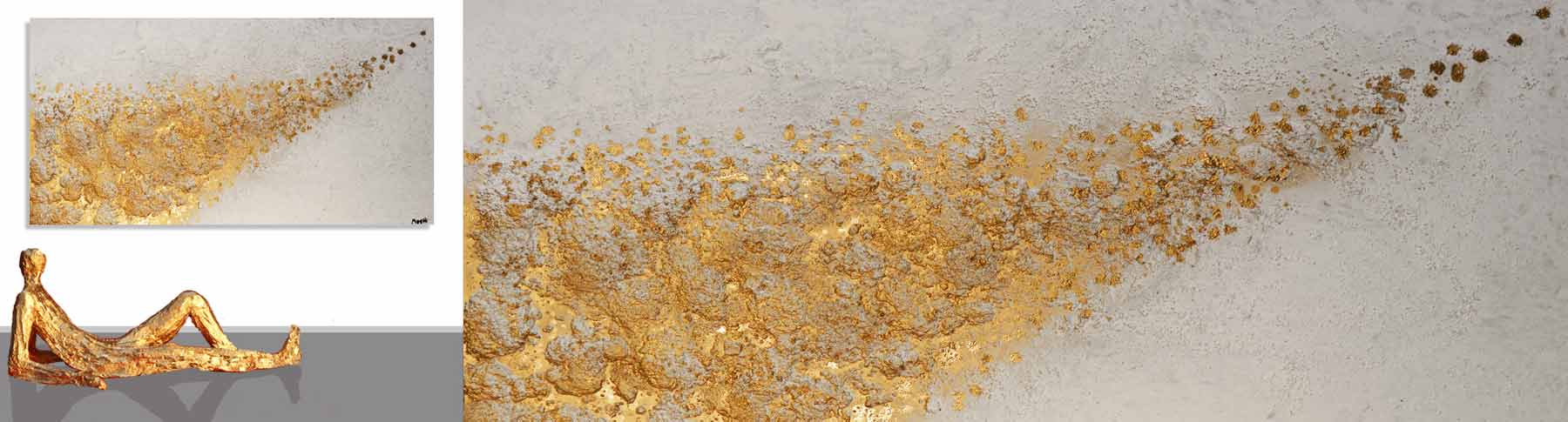
The difference begins with the material. While conventional wall paintings have a flat surface, Maria Moretti works with pastose masses – sometimes several centimetres thick. Sand, ground stone and mineral pigments are worked directly into the paint. The result: a tactile surface with real relief character that can barely be captured fully in photographs.
These works belong to the genre of impasto painting – a term from art history describing paintings in which paint is applied in thick, visible layers. Vincent van Gogh, Gerhard Richter and Claude Monet used this technique. Maria Moretti develops it further by integrating natural materials such as sand and stones directly into the paint mass.
The palette knife technique – how impasto paintings are made
The painting knife is the most important tool. Not the brush. With wide, flat blades the mass is drawn across the surface – sometimes in long strokes, sometimes in short, abrupt movements. The paint cannot be retouched. What is on the surface once stays. This makes the technique honest: there is no way to paint over a mistake without destroying the texture.
This is why Maria Moretti calls these her favourite works. Not because they are the easiest – quite the opposite. But because every decision is final. The result directly and uncorrected mirrors the moment in which the work was created.
Drying time is a separate part of the process. Depending on the layer thickness, it can take days until a work has fully hardened. If you continue too early, the mass cracks. Wait too long and the next layer no longer adheres. Hitting this window is a matter of experience.
Anyone wishing to compare different techniques – whether with pastose oil paint or mineral paste – will find a detailed overview under Painting Techniques. The difference in result is considerable: oil paint remains soft and flexible in texture; mineral pastes with sand produce a harder, grainier surface with more tactile presence.
Materials that remain visible
Maria Moretti works with a mixture of mineral pastes, pigments and sand as well as natural stone granules. These materials are not hidden – they are the expression. Those who look closely see the grain of the sand, the texture of the stone, the layering of the paint.
The colour palette in Maria Moretti's impasto paintings is deliberately reduced. White, beige, grey, gold, black – rarely more than two or three tones per work. This is not a limitation, it is intention. Too many colours in a palette knife work fight against the texture. Using few lets the texture speak. That is the real art of this genre: knowing what to leave out.
In the monochrome and metallic variants in particular, this materiality develops its own effect. Gold on white relief: that is not a colour applied – it is light captured. Silver-grey in high texture: cool metallic meets organic irregularity. No printer in the world can reproduce that.
Formats and impact in the room
Impasto paintings work in small formats (from 35 × 35 cm) as a precise statement – a single accent that shows character without dominating. In large formats (from 150 × 80 cm upwards) they become a room-defining force. The wall behind recedes. The work takes over.
For high rooms with a lot of wall space, multi-part works are suitable. Three panels side by side, coordinated but not identical – each with its own texture, together forming a composition. This gives flexibility in placement and allows later rearrangement.
Some practical reference points:
- 35–60 cm: sideboard, bookshelf, small alcove
- 80–100 cm: solo statement above a sofa or bed
- 120–160 cm: main wall in living room, hallway, hotel lobby
- 180–250 cm: reception room, entrance hall, open-plan office
The right work for your interior
Impasto paintings are not stylistically neutral objects. They carry weight – visually and physically. It is therefore worth briefly considering what the room already brings before deciding on a work.
Nordic style: light wood, white walls, minimal decoration. A monochrome impasto painting in white or grey reads as a logical continuation of the interior language – only deeper, more plastic, more interesting. Gold as an accent sets a counterpoint without overwhelming.
Modern interior: clean lines, dark floors, exposed concrete. A large-format work in black or anthracite with metallic elements emphasises this language. Alternatively, a warm beige-gold acts as a deliberate contrast – warm against cool, organic against geometric.
Classic-elegant rooms: stucco, natural stone, fine fabrics. Gold impasto paintings with high texture integrate seamlessly. The materiality of the work corresponds with the material richness of the room without competing.
Hospitality and hotels: in lobbies, restaurant areas and guest suites, impasto paintings set a professional note. They read as representative without being merely decorative. Maria Moretti also produces individually adapted formats for commercial spaces.
For those unsure how a work would look in a specific room: Maria Moretti offers a free photo montage. Simply send a photo of the wall – the work will be placed there before a decision is made.
Metallic tones – why gold and silver work so well
There is a reason gold has not disappeared from interior design for decades: it reacts to light differently from any other colour. Not reflective like a mirror, but warm, changing, alive. In a palette knife structure this effect is amplified. The uneven surface captures light at hundreds of small angles – depending on position and time of day, a different image emerges.
Silver and platinum tones work differently: cooler, more distanced, more precise. They suit rooms that emphasise clarity. Combined with white or a deep grey, works emerge that begin restrained and only reveal their full depth on second glance.
Maria Moretti puts it this way: gold is the material that promises value – and delivers it when used correctly. Not as overwhelming presence, but as statement. A single gold stripe in a monochrome white work can shift the entire mood of a room. It works because the eye finds gold immediately – and then stops searching.
Custom orders – when standard formats don't fit
Architecture is rarely standard. Sloping walls, unusual proportions, niches with measurements for which no catalogue work fits. Maria Moretti accepts Paintings Order in all formats and colour schemes. This includes multi-part polyptych works tailored to a specific wall situation.
For the commercial sector – office art, practice rooms, hotels – works are coordinated with the colour scheme and room concept on request. Colours, formats, mood: all negotiable. The only requirement: the technique and the handwriting of Maria Moretti remain recognisable.
Care and durability – what really matters
Palette knife works made from mineral paste and natural materials are more robust than they look. The surface is permanently stable after full hardening. Some guidelines for everyday life:
- No direct washing or rubbing – the texture can be damaged
- Remove dust with a soft brush or air nozzle, do not wipe
- Avoid prolonged direct sunlight – pigment shifts are possible
- Keep moisture and temperature fluctuations within limits
The materials are designed for longevity. Works from Maria Moretti's studio have a proven durability over many years – including in commercial spaces with changing conditions.
Frequently asked questions about impasto paintings
- How heavy is a large-format impasto painting?
- Which wall fixture is suitable for palette knife works?
- Can I order an impasto painting in specific colours?
- How long does a custom order take?
- Are impasto paintings suitable for humid rooms like bathrooms?
What are impasto paintings and how are they made?
Impasto paintings are works with a three-dimensional surface, created by applying thick layers of paint, mineral pastes, sand and stone granules. The technique is called impasto or palette knife painting: instead of brushes, painting knives and spatulas are used. The result is a real relief that reacts to light and changes depending on the viewing angle. Maria Moretti also works with natural materials like sand and stones that are integrated directly into the paint mass.
How do I safely hang a heavy impasto painting?
Large-format impasto paintings can be considerably heavier than comparable prints due to the thick material layers. For works from 80 × 80 cm: a picture rail is recommended or two wall hooks that distribute the weight evenly. In plasterboard walls, plugs with sufficient load capacity are essential. If in doubt, check the product description – weight and recommended fixing are provided on request.
Can I order an impasto painting in a specific colour or format?
Yes. Maria Moretti produces impasto paintings on request in individual colour schemes and formats. For custom orders, a request with the desired format is sufficient. A colour idea and – if available – a photo of the room are additionally helpful. A concrete offer is created based on this information. Delivery time for individually produced works is typically 3–6 weeks depending on format and complexity.
Are impasto paintings suitable for offices and commercial spaces?
Impasto paintings are excellently suited for commercial environments. They read as representative without being merely decorative – an important distinction in professional contexts. For offices, practices, hotels and hospitality, works are coordinated with the room concept and colour scheme on request. Maria Moretti has experience with larger wall surfaces and multi-part installations.
How do impasto paintings differ from splash paintings or abstract works?
The main difference lies in the surface and the technique used. Impasto paintings have a relief-like, tangible surface made from pastose masses and natural materials – the texture is visible and palpable. Splash are created through paint movement and have a flatter, flowing quality. Impasto paintings are the most material-intensive works across all categories.
Can I see an impasto painting in my room before buying?
Yes – Maria Moretti offers a free visualisation service. Send a photo of the wall and the work will be inserted digitally. This allows format, colour effect and placement to be assessed before purchase. This service is non-binding and free of charge.
Are impasto paintings suitable for humid rooms like bathrooms?
Works on organic support material are generally not ideal for permanently humid environments. In normal bathrooms with good ventilation, placement is possible if the work is not directly exposed to steam or splashing water. For wellness areas or rooms with high constant humidity, prior consultation is recommended.
What is the delivery time for impasto paintings?
Stock works are typically dispatched within 3–5 working days. Shipping is free worldwide, well packaged for transport. For custom orders, a production time of 3–6 weeks applies. A binding delivery date is confirmed upon receipt of the order.
What is the difference between impasto technique and palette knife painting?
Impasto is the art-historical umbrella term for any painting technique in which paint is applied in thick, visible layers – regardless of the tool. Palette knife painting is a specific variant using painting knives and spatulas instead of brushes. Maria Moretti combines both approaches and extends them by integrating sand and mineral materials, raising the texture beyond what is possible with pure oil paint or acrylic paste.
Further works with distinctive material expression can be found in the categories Contemporary Artworks, Modern Artworks and Splash. For interior projects with multiple works, take a look at custom orders – or contact the studio directly.
Other categories that connect thematically: Metal, Otto, Bauhaus, Lounge & Retro, Figurative Art, Watercolor, Oil Paintings, Office Art, Art Studio, Artist, Painting Techniques.