Abstract pictures – Action Painting & Splash Technique
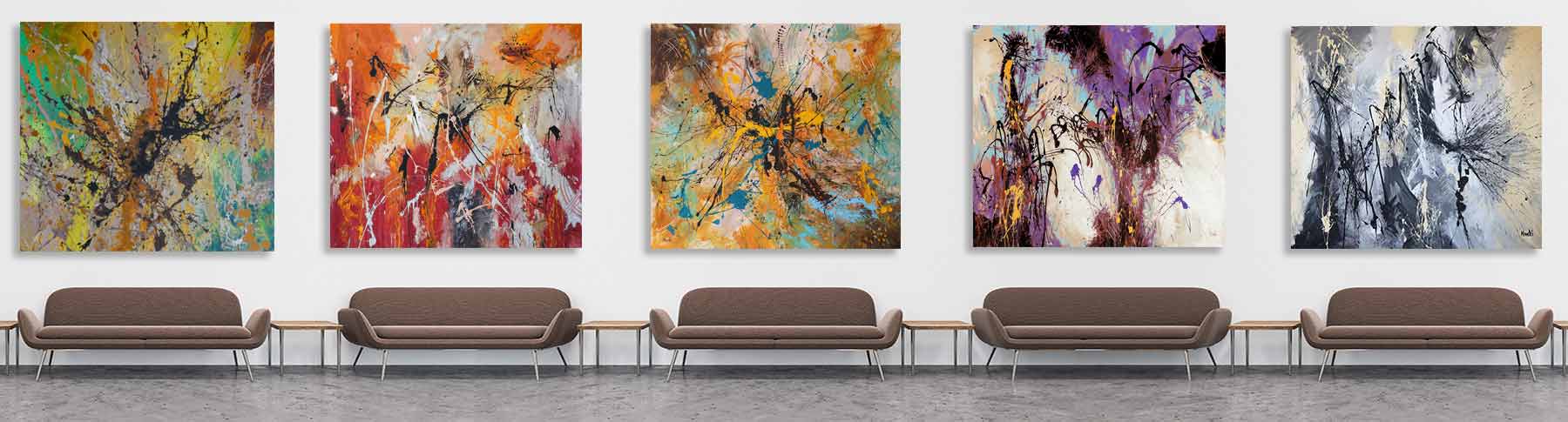
Abstract pictures by Maria Moretti combine colour, movement and controlled spontaneity. Each work develops its character through layering, dynamics and deliberate contrasts. Strong gestures and a clear pictorial structure ensure that every piece works from different angles. Some works appear calm and reduced, others energetic and impulsive. What matters is not a fixed motif but the effect in the room.
The series around the Splash Technique and Action Painting shows a direct, physical engagement with colour. Drips, lines, densities and open areas create tension. The result is not a random accumulation of colour but a controlled composition with clear direction.
Abstract pictures – reinterpreted
Abstract pictures do not work with a classical narrative scene. Colour, rhythm, structure and movement take the lead. The result is works that remain open to different interpretations. A painting can look completely different depending on the light, time of day or surroundings.
What defines abstract pictures:
- No realistic depiction – forms, colours and lines detach from the figurative source
- Open interpretation – every viewer brings their own reading
- Composition over motif – structure, rhythm and colour mood determine the effect
- Spatial relevance – abstract pictures actively change the atmosphere of a room
- Craftsmanship – layering, glazes and brushstrokes create physical presence
- Timelessness – no narrative content that can become dated
Maria Moretti uses various techniques to build depth and tension. Thin glazes meet dense colour fields. Fine lines stand beside powerful gestures. Some areas remain deliberately open; others are reworked multiple times.
Action Painting and Splash Technique
The Splash Technique and Action Painting are among the best-known forms of modern contemporary art. Paint is not applied carefully but hurled, dragged or distributed dynamically. The result is spontaneous movements with visible energy.
Jackson Pollock is regarded as the most important representative of this movement. The American painter and leading figure of Abstract Expressionism in the New York School established Action Painting as an independent style. Pollock worked directly on canvas laid on the floor – the body became the tool, movement became the visual language.
Other key representatives of Abstract Expressionism:
- Helen Frankenthaler – developed the Soak-Stain Technique
- Cy Twombly – combined writing, drawing and spontaneous application of paint
- Franz Kline – worked with large-scale black-and-white compositions
- Lee Krasner – major representative of Abstract Expressionism
- Mark Rothko – created a meditative form of abstract art
Art history of abstract pictures
The development of abstract art began at the start of the 20th century. Wassily Kandinsky increasingly detached colour and form from realistic motifs and is regarded as one of the most important pioneers. Abstract Expressionism emerged in the 1940s and 1950s in the USA – the first major American art movement with international influence. In Europe, Informel and Tachisme developed in parallel as related movements.
What effect does non-figurative art have in a room?
Abstract pictures change the perception of a room more than many other decorative elements. Colour guides the eye, influences the quality of light and creates depth. Bright compositions open up spaces visually. Darker works create contrast and presence.
- Warm tones such as ochre, beige or red feel homely and powerful
- Black-and-white compositions appear more reduced and contemporary
- Strong accent colours can deliberately create tension and draw attention
- Landscape formats work particularly well in spacious, open rooms
- Portrait-format works appear more elegant and emphasise ceiling height
- Square formats create calm, symmetry and balance
The right artwork for your interior
Choosing the right abstract picture depends on room size, colour mood and desired atmosphere.
- Minimalist interior: one large abstract picture as the central focal point
- Warm, organic living space: earthy tones, soft forms – harmonious integration
- Industrial style: black-and-white compositions or textured surfaces
- Classically furnished rooms: vivid colour compositions set deliberate accents
The free room visualisation shows how a picture will look in your space – before you decide.
Material, technique and surfaces
All works are created by hand on canvas using high-quality pigments and professional paints. Depending on the piece, the surfaces are matt, silky or textured. Some works show pronounced layering and relief-like areas.
The creative process of an abstract picture:
- The starting point is a colour idea, a mood or a compositional concept
- Initial colour layers establish the basic structure
- Spontaneous gestures, drips and deliberate brushwork develop dynamics
- Multiple reworkings create depth and tension
- Deliberately left-open areas create room for interpretation
Further inspiration: Impasto Paintings, Contemporary artworks, Bauhaus and Modern Artworks.
Artworks for living spaces, offices and practices
Modern wall art is widely used to make spaces look more professional and refined. In offices, dynamic colour fields promote concentration and creativity. Practices prefer calmer compositions. Hotels and reception areas favour large-format statement pieces.
- Office art – curated selection for offices, law firms and businesses
- Art for your practice – calm compositions for medical spaces
- Metal paintings – special effects with metallic surfaces
- Lounge & Retro – dekorative Kraft mit Vintage-Charakter
Originals instead of reproductions
All works are originals – no prints, no industrial reproductions. Small irregularities, visible traces of paint application and individual surfaces are part of the artistic signature. Related categories: Contemporary artworks, Watercolor, Figurative art, Oil paintings, Landscapes, Floral artworks, Animal portraits und Artist.
FAQ – frequently asked questions
What is an abstract picture?
An abstract picture shows no realistic scene in the classical sense. Instead of people, landscapes or objects, colour, movement, structure and composition take centre stage. Forms can be suggested, reduced or freely interpreted. Modern abstract pictures often work with contrasts, layering and spontaneous gestures – the effect comes not from the motif but from the visual language itself.
Who founded Action Painting?
Jackson Pollock is regarded as the founder of Action Painting. The American painter developed a new painting technique in the 1940s: he laid the canvas on the floor and poured, splattered or dripped paint onto it – the body became the tool. Pollock was a key representative of Abstract Expressionism in the New York School and has shaped the development of modern art to this day.
What is the Splash Technique?
The Splash Technique is a painting method in which paint is not applied in the traditional way but hurled, splattered or poured. The result is spontaneous drips, lines and colour areas with visible energy. The technique is closely linked to Action Painting and was made famous above all by Jackson Pollock. Maria Moretti combines the Splash Technique with deliberate pictorial structure – the composition remains controlled, the dynamism visible.
What size is right for abstract artworks?
It depends on the wall area and viewing distance. As a rule of thumb, the picture should cover no more than 2/3 of the wall width. Large landscape formats work particularly well above sofas or sideboards. Portrait formats suit narrow walls or entrance areas. Square works create a calmer, more symmetrical effect. The free room visualisation helps when in doubt.
Which colours suit modern interiors?
Beige, black, white and warm natural tones are particularly versatile. Strong accent colours work well when a room should feel deliberately more dynamic. What matters is that at least one colour from the picture reappears in the interior – in a cushion, a rug or a piece of furniture. This creates visual connection without overwhelming the space.
How is a work created in the studio?
The process usually begins with a colour idea or a rough composition. The work then develops step by step. Some areas are reworked several times; others remain deliberately spontaneous. Many pictures are built up in layers – transparent glazes meet opaque colour fields. Large-format works in particular are viewed repeatedly from different angles before a piece is considered finished.
Are these kinds of artworks suitable for offices?
Yes. Modern wall art is widely used in offices, practices and reception areas because it makes spaces feel more structured and refined. Dynamic colour fields promote creativity; calmer compositions create a focused atmosphere. The choice depends on the desired effect – more on this under Office art.
Are all works originals?
Yes. All works by Maria Moretti are made by hand on canvas and shipped directly from the studio. No prints, no reproductions – each work exists once. Visible traces of the creative process and individual surfaces are part of the deliberate artistic signature.
What role does the surface play?
The surface has a significant influence on light effect and depth. Textured works with visible layering change their appearance far more depending on the time of day and the direction of light than smooth surfaces do. Sidelight highlights relief structures particularly well.
How are the pictures delivered?
All works are professionally packed and shipped securely worldwide – at no extra charge. All information on ordering and shipping: Art shop.
What does the term abstract mean?
Abstract means: no naturalistic depiction. Forms, colours and lines detach from the real source and develop their own visual language. This creates space for interpretation and personal perception – from geometric rigour to expressive spontaneity.
Who is the most famous representative of this art movement?
Jackson Pollock is regarded alongside Wassily Kandinsky as the best-known representative of abstract art. Kandinsky is seen as the founder of abstract painting. Pollock became world-famous through Action Painting. Other key names: Mark Rothko, Franz Kline, Willem de Kooning and Lee Krasner.
How do you photograph in an abstract style?
Abstract photographs are created through unusual perspectives, motion blur, light reflections or extreme close-ups. Many photographers work with reflections, macro shots or deliberately blurred areas. The aim is not documentary representation but a visual effect from colour, structure and form.